This curated collection represents the core intellectual and research pillars of our founder, Ramin Saadat. The repository is meticulously organized into two strategic sections: Books, which provide the essential long-form philosophical foundations and comprehensive frameworks of his thought, and Articles, which offer targeted scientific investigations into neurophysiology, cognitive systems, and the systemic sources of human ignorance. Each work is designed to challenge established paradigms and foster deeper epistemic clarity in a complex world.
THE FOUNDER’S BOOKS
Major philosophical frameworks and comprehensive studies on human cognition and behavior.
Springs of Ignorance in the 21st Century
Ramin Saadat

An analytical investigation into the modern world examining the “Unholy Triangle of Ignorance” (pseudo-science, pseudo-philosophy, and superstition). This work bridges classical skepticism with contemporary digital challenges, deconstructing how technological convenience and intellectual inertia cloud critical human reasoning.
Common Sense: The Last Bastion in the Age of Illusion
Ramin Saadat
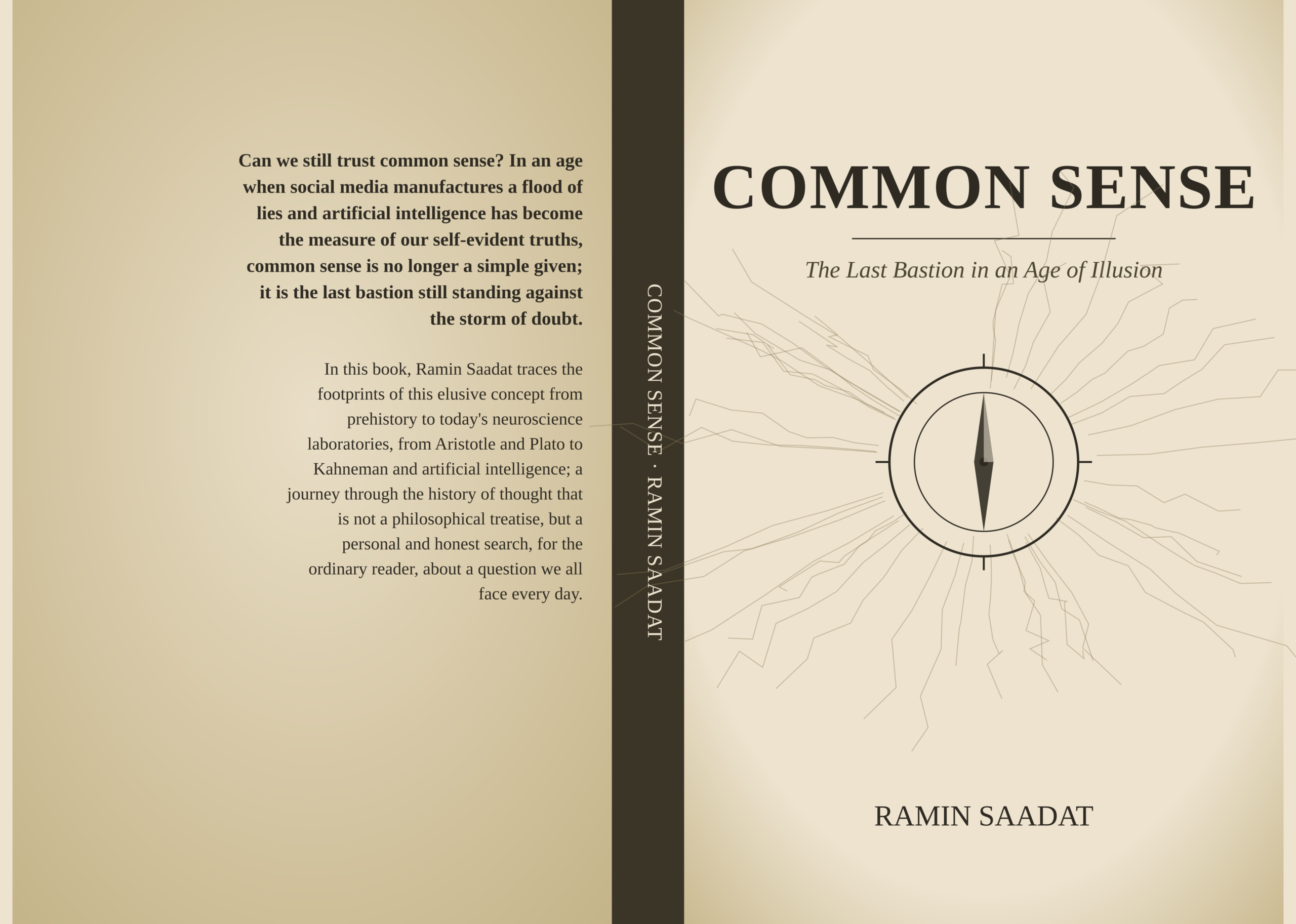
A critical inquiry into the crisis of human reasoning in the era of Artificial Intelligence. Saadat warns against the systemic erosion of biological, carbon-based cognition as independent human judgment is progressively outsourced to algorithmic silicon architecture and automated answers.
PERPETUAL CHILDHOOD: Nonage and Maturity
Ramin Saadat
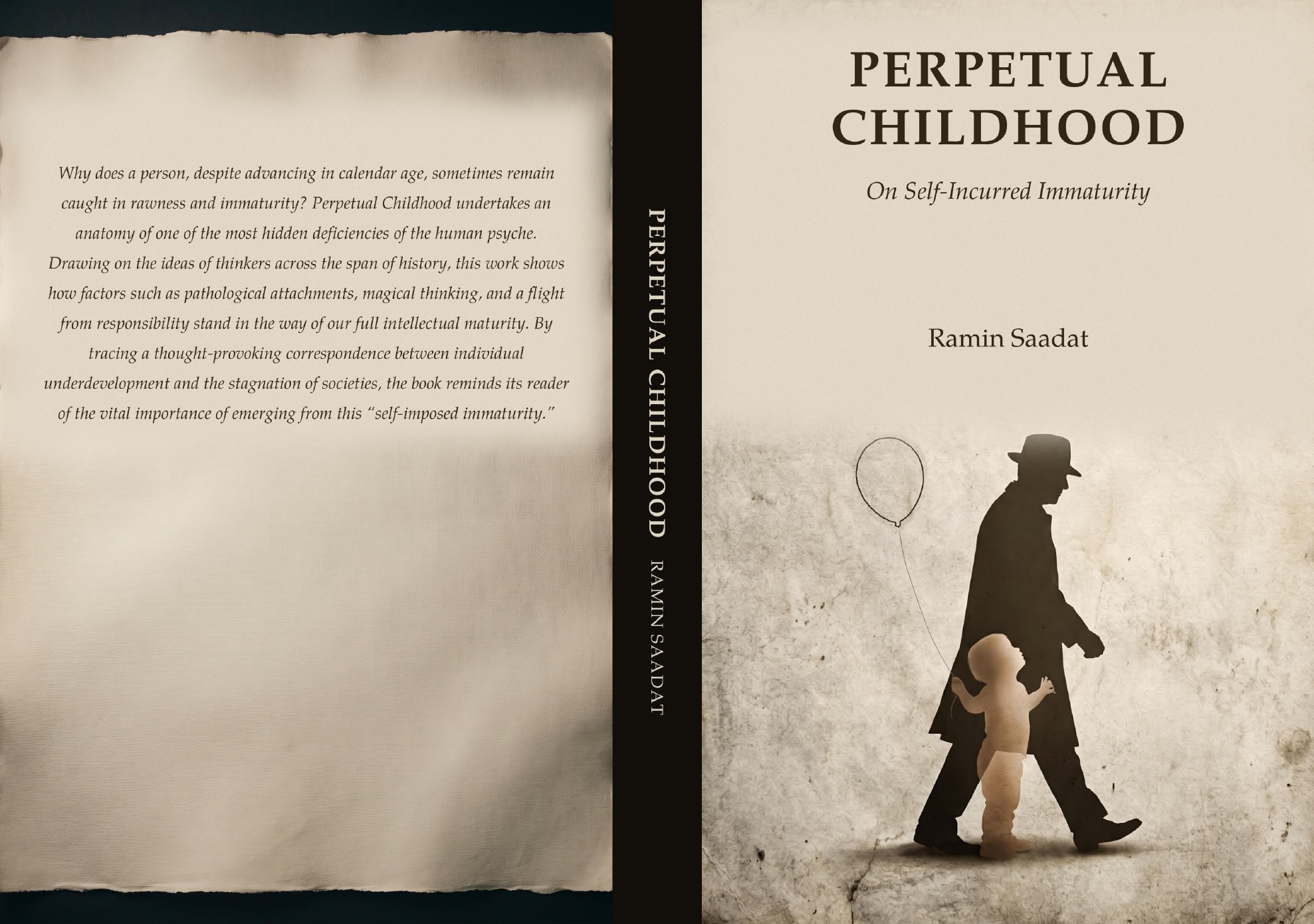
A comprehensive study on psychological immaturity and social stagnation. Drawing from historical and contemporary thought, this volume analyzes adult “childishness” and the structural mechanisms of collective societies that systematically fail to achieve intellectual autonomy and moral maturity.
THE BOOK AND ITS ENEMIES: Should We Still Read?
Ramin Saadat

A philosophical defense of the written word in an era of fragmented digital attention. Saadat traces the historical significance of books as humanity’s paramount cognitive tool, examining modern cultural threats that risk degrading deep reading and reflective human thought.
An Introduction to the Nature of Ignorance (Vol. 1)
Volume 1: Concept of Ignorance, Ancient Civilizations and Cultures

The foundational volume of a multi-volume epistemic series. Traversing ancient myths, Mesopotamia, Persia, and Greece, this work deconstructs ignorance as both a theoretical concept and a practical condition, establishing the historical groundwork for agnotology and modern ignorance studies.
An Introduction to the Whatness of Ignorance (Vol. 2)
Volume 2: The Concept of Ignorance in World Religions (Judaism, Christianity, and Islam)

The second volume of the epistemological series exploring the concept of ignorance within Abrahamic religions. Examining sacred texts, apophatic theology, original sin, and religious archetypes, this study analyzes how darkness, blindness, and compound ignorance have been conceptualized and institutionalized across theological traditions.
From Soil to Soul: Memoirs of an Agricultural Engineer
Ramin Saadat
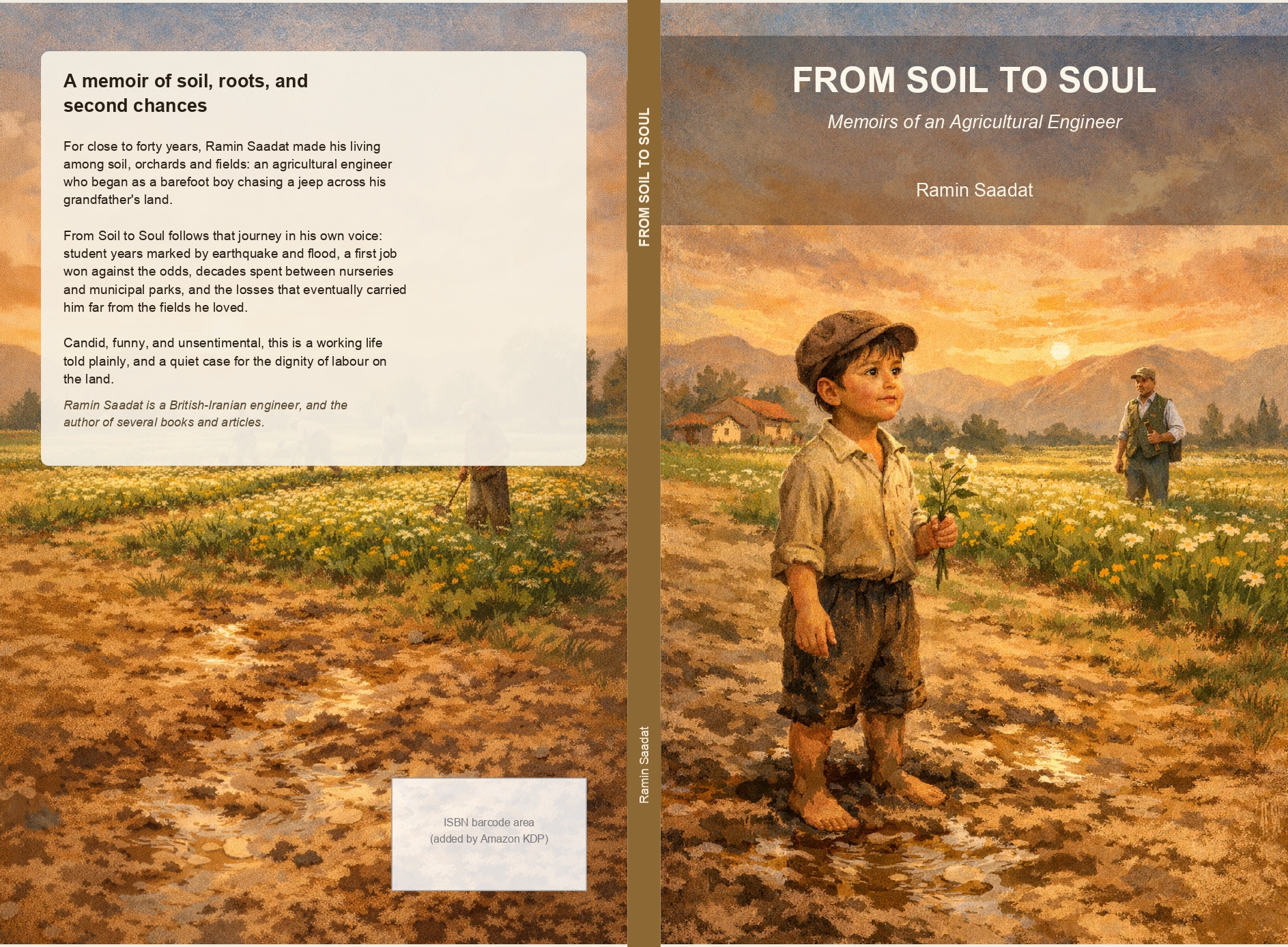
A deeply reflective biographical memoir spanning four decades in agricultural engineering, plant protection, and green spaces. Saadat blends personal narratives, from student struggles and surviving major historical disasters to exile and professional resilience, with philosophical insights on work, nature, and the human journey.
Possession
A Three-Channel Model for the Hackability of Learning Systems
Author: Ramin Saadat

A Theoretical Monograph on Systems Hackability & Epistemic Vulnerability.
This scholarly monograph introduces a unified, falsifiable framework explaining why open, adaptive learning systems (from biological organisms and plant pathways to human minds and artificial intelligence) are inherently susceptible to external hijacking. Synthesizing evidence across neurobiology, memetics, and computational models, it presents the Three-Channel Model of Possession.
* Language: English | Format: Paperback | Publisher: Amazon KDP (Published: 2026) | ISBN: 9798176340327
PART II: ARTICLES & RESEARCH PAPERS
A collection of focused scientific inquiries into neurophysiology, cognition, and ignorance studies.
073
Feigning Ignorance: A Question about a Performance
Ramin Saadat
This article defines feigned ignorance as a deliberate, knowing display of not-knowing, and distinguishes it from seven neighbouring behaviours. Assessing eight historical cases by evidence quality, it argues that successful performances leave no trace, so frequency cannot be measured, and proposes three criteria for judging probability, leaving six questions open.
DOI: 10.5281/zenodo.23945784
072
The Other Side of Industrial Ignorance-Making: Did Society’s Response Change After Disclosure?
Ramin Saadat
This third paper in the series maps the existing evidence on intent, effect and post-disclosure change across six industrial sectors, using a repeatable OpenAlex search. It finds intent and company consequences documented, but the public’s belief and behaviour after disclosure remain unmeasured; an absence of evidence, not of effect.
DOI: 10.5281/zenodo.23911348
071
Industrial Ignorance-Making After Tobacco: A Case Review of Six Selected Sectors Based on the 28-Strategy List
Ramin Saadat
Extending agnotology beyond tobacco, this study examines six other sectors (food, social media, opioids, chemicals, alcohol and talc) against Goldberg and Vandenberg’s 28-strategy list of doubt-making. It finds a documented knowing-saying gap in all six, with suppressing information and influencing regulators recurring most, though findings are not generalisable.
DOI: 10.5281/zenodo.23771023
070
The Interaction of Ignorance and Science: Beyond Simple Opposition. A Review of the Evidence
Ramin Saadat
Challenging the view that science and ignorance are simple opposites, this review asks when ignorance helps or harms science. It surveys five productive roles ignorance can play, how disciplines measure it differently, and four ways it does harm, concluding the effect depends on whether it is seen and chosen.
DOI: 10.5281/zenodo.23663864
069
The Place of Agnotology in the Field of Ignorance Studies and Industrial Doubt-Making: A Bibliometric Study
Ramin Saadat
Using OpenAlex bibliometric data, this study asks whether “agnotology” has drifted from Proctor’s original meaning of ignorance as strategic production. It finds the word’s use has expanded without clear drift, while research on industrial doubt-making continues largely outside it, in a parallel tradition of its own.
Supplementary materials (datasets used in the analysis) are archived under the same DOI.
DOI: 10.5281/zenodo.23587485
068
Is Understanding Pleasurable? The Existing Evidence, the Conditional Pleasure Hypothesis and Its Implications for Ignorance Studies
Ramin Saadat
Is understanding pleasurable? Reviewing scattered evidence on aha moments, curiosity and information avoidance, this article proposes the “conditional pleasure” hypothesis: understanding is pleasant only when a perceived gap closes cheaply, fits one’s disposition, and doesn’t threaten identity or interests, explaining why ignorance can persist.
DOI: 10.5281/zenodo.23454300
067
The Illusion of Sufficiency: Is Critical Thinking Skill Enough?
Ramin Saadat
The third article in the “Illusion of Sufficiency” trilogy separates critical thinking’s “skill” from its “disposition” component, arguing the gap between them is real but modest, carries social costs through identity-weaponised “vice-charging”, and that disposition training works only when targeted directly, with reliable, non-self-report measures.
DOI: 10.5281/zenodo.23309377
066
The Illusion of Sufficiency: Can Knowing the Names of Cognitive Biases Cure the Ignorance of Our Age?
Ramin Saadat
This second article in the “Illusion of Sufficiency” trilogy shows that knowing a bias’s name does not correct it in practice, a gap it calls “meta-ignorance”. It traces how the label becomes an identity weapon, loses scientific grounding in public discourse, and argues correction needs practice, not naming.
DOI: 10.5281/zenodo.23242234
065
The Illusion of Sufficiency: Can Knowledge of Fallacies Alone Cure the Ignorance of Our Age?
Ramin Saadat
This article, the first in the “Illusion of Sufficiency” trilogy, argues that list-based knowledge of logical fallacies is insufficient to counter manufactured ignorance. Drawing on structural analysis and contested empirical evidence, it shows that recognising argumentative forms does not equate to assessing truth, while the label “fallacy” often becomes a weaponised identity marker.
DOI: 10.5281/zenodo.23186514
064
Should We, Like Artificial Intelligence, Sometimes Rewrite Our Thinking From Scratch? What Separates Machine From Human
Ramin Saadat
This article examines the “turn-based information structure” in AI, showing how piecemeal information leads to unreliability as models anchor on initial inputs. Comparing this to human cognition, it distinguishes a shared “cold layer” of anchoring from a human-exclusive “warm layer” of identity-linked commitment, concluding that a behavioural test of reconstruction is needed to identify premature commitment.
DOI: 10.5281/zenodo.23096894
063
Sophisticated Ignorance and Our Relation to Reality
Ramin Saadat
This article examines the third face of ignorance, “sophisticated ignorance,” where a system sets its own reference domain and resists correction by rewriting feedback from reality. It proposes the criterion of “unabsorbed resistance of reality” and traces this mechanism across six documented cases.
DOI: 10.5281/zenodo.23053369
062
Ignorance as Affirmation: A Look at the Theoretical Challenges Surrounding the Positive Dimension of Ignorance
Ramin Saadat
This paper explores the “positive dimension” of ignorance, where ignorance is viewed as an external agent added to the subject rather than a lack of knowledge. Tracing this concept historically, it reveals how externalising the cause of error persists today through secular concepts like algorithmic manipulation.
DOI: 10.5281/zenodo.22953581
061
The Ominous Triangle of Ignorance: Proposing a Three-Axis Analytical Framework in Ignorance Studies
Ramin Saadat
This paper introduces the “ominous triangle of ignorance” (comprising superstition, pseudoscience, and pseudo-philosophical nonsense) as a three-axis analytical framework. It examines empirical evidence linking these beliefs through shared cognitive styles, evaluates their stable prevalence despite rising content density, and documents their growing influence on policy.
DOI: 10.5281/zenodo.22854473
060
Interdisciplinary Evidence for a Shared Mechanism Underlying the Three-Channel Model of Possession
Ramin Saadat
This paper examines cases where a limited diagnostic cue alters a system’s decision without changing the underlying reality, across biological instincts, human cognition, and AI models. It reveals a shared vulnerability: reliance on limited cues makes all three previously identified channels of possession possible.
DOI: 10.5281/zenodo.22808518
059
What the Hand Does: A Neglected Contribution to Smartphone Appeal
Ramin Saadat
Research on smartphone engagement and dependency has been framed largely around cognitive, social and neurochemical reward mechanisms, particularly dopamine. This paper proposes that these accounts need to be complemented by a sensorimotor perspective: the smartphone is not simply an information device, but an interactive in-hand tool that draws on deeply established human abilities to grasp, manipulate, control and respond to objects.
DOI: 10.5281/zenodo.22762969
059
What the Hand Does: A Neglected Contribution to Smartphone Appeal
Ramin Saadat
This paper argues that cognitive and social explanations for smartphone dependency overlook a crucial sensorimotor dimension. Drawing on evolutionary history and neurophysiology, it proposes that the smartphone functions as an interactive in-hand tool, engaging deeply established human capacities for object manipulation and tactile reward.
DOI: 10.5281/zenodo.22762969
058
How Much Precision Is Really Enough? A Look at the Precision of Writing in an Age of Unlimited Judgement
Ramin Saadat
This article argues that the unlimited critique supplied by large language models creates endless revision loops. Drawing on philosophy, sociology, and cognitive economics, it reframes the issue as a problem of stringency, showing how boundless demands for precision function as an agentless mechanism of ignorance production.
DOI: 10.5281/zenodo.22669692
057
Emergent Ignorance in the Digital Age: Linking Qualitative Ignorance Studies and Network Epistemology
Ramin Saadat
Connecting qualitative ignorance studies with formal network epistemology, this paper examines structural, agentless ignorance in digital networks. Evaluating mathematical models alongside empirical evidence, it distinguishes individual false belief, circulating misinformation, and network-rooted structural ignorance to bridge these two independent literatures.
DOI: 10.5281/zenodo.22522041
056
Ignorance as Absence: A Look at the Theoretical Challenges Surrounding the Negative Dimension of Ignorance
Ramin Saadat
This paper addresses negative ignorance, defined as the absence of knowledge. Rereading classical philosophical traditions, it demonstrates that the primary challenge in classifying negative ignorance is not its negative nature, but the absence of a pre-given reference domain, necessitating theoretical or institutional stipulation.
DOI: 10.5281/zenodo.22163159
055
The Classification of Ignorance and Its Challenges: A Comparative Review of Pre-modern and Contemporary Traditions
Ramin Saadat
This paper reviews pre-modern and contemporary efforts to classify ignorance, identifying five shared challenges across traditions. Demonstrating how disciplinary backgrounds shape classificatory axes, it proposes explicit axis transparency to increase comparability and prevent conceptual repetition under differing terminology.
DOI: 10.5281/zenodo.22066729
054
Has Public Ignorance Really Increased in Our Time? A Critical Examination of the Claim, Broken Down into Measurable Cases
Ramin Saadat
This paper tests the widespread claim that public ignorance has grown in the information age. Evaluating survey data across nine domains, it shows that ignorance functions as a multi-component vector, revealing heterogeneous trends rather than a single uniform decline.
DOI: 10.5281/zenodo.21992616
053
When Questioning Entrenches Ignorance: Rereading the Socratic Method through Ignorance Studies for Today’s World
Ramin Saadat
Re-examining the Socratic method through ignorance studies, this paper argues that while effective against simple not-knowing (agnoia), successive questioning fails against double ignorance (amathia). Drawing on Platonic dialogues and social psychology, it demonstrates how public exposure of contradiction can entrench identity-rooted beliefs rather than correct them.
DOI: 10.5281/zenodo.21902264
052
Has the Transformation of America’s Energy Position Changed Washington’s Calculations on the Strait of Hormuz, and Made It Less Eager to Resolve the Crisis?
Ramin Saadat
This article examines how America’s shift to a net energy exporter altered its strategic calculations regarding the Strait of Hormuz. Analyzing production and trade data, it argues that while Washington’s direct vulnerability has decreased, broader global economic risks still constrain U.S. policy choices.
DOI: 10.5281/zenodo.21820170
051
Quantifying Fragmentation in Ignorance Studies: A Statistical Test of the Three-Stream Model
Ramin Saadat
This bibliometric study analyzes 5,658 OpenAlex articles to test interdisciplinary fragmentation across ignorance studies. Examining 10,856 citation edges, it reveals a significant downward trend in cross-stream citations, driven primarily by stream size imbalances and early divergence rather than recent crisis events.
DOI: 10.5281/zenodo.21794275
050
Ignorance in the Mirror of Nations’ Languages: A Comparative Etymological and Semantic Study of the Concept of Ignorance in Seven Linguistic Traditions
Ramin Saadat
This study examines ignorance across seven traditions: Chinese, Sanskrit, Hebrew, Greek, Latin, Persian, and Arabic. It traces the Indo-European *gneh3- root across four languages, highlights Arabic’s independent Semitic vocabulary, and uncovers a shared pattern of value reversal, transforming ignorance from a flaw into a virtue.
DOI: 10.5281/zenodo.21772781
049
If AI Is a Parrot, What Are We? Rethinking the Criteria for Human Understanding in Light of Artificial Intelligence
Ramin Saadat
This paper examines machine understanding across world models, meaning, access, and phenomenal consciousness. Reviewing mechanistic interpretability, it demonstrates that criteria denying understanding to AI (post hoc rationalisations, heuristics, fragile benchmarks) equally implicate humans. While biological autopoiesis remains a distinction, parrot-like reasoning is a spectrum shared by both.
DOI: 10.5281/zenodo.21724041
048
Why Quantifying Ignorance Is Difficult: The Challenges of Data-Driven Study Across Three Faces of Ignorance
Ramin Saadat
This article argues that data-driven measurement of ignorance faces a stepped structural impossibility across its three faces: negative (absence), positive (manufactured doubt), and sophisticated ignorance (deeply held false belief). Grounded in conceptual analysis and four empirical case studies, it demonstrates that quantification collapses from empirical constraints to a principled inconsistency, reversing diagnostic signals.
DOI: 10.5281/zenodo.21629276
047
Is Attention to Ignorance Growing? A Data-Driven Look at Developments in Ignorance Studies in the Twenty-First Century
Ramin Saadat
Analyzing OpenAlex and Google Trends data (2000–2025), this study statistically confirms a significant increase in academic and public attention to ignorance studies. A Pettitt test identifies a structural break between 2011 and 2012. The paper argues this sustained growth highlights the urgent need for a coordinating framework.
DOI: 10.5281/zenodo.21535776
046
When AI Says “Honestly”: Honesty and Sycophancy as Two Sides of the Same Coin in the Speech of Language Models
Ramin Saadat
Tracing the phrase “to be honest” in language models, this essay examines honesty and sycophancy as intertwined phenomena. Drawing on discourse markers, literature, and empirical findings, it shows sycophancy is a default stance in power relations and argues human-approval training cannot distinguish genuine honesty from its persuasive display.
DOI: 10.5281/zenodo.21443649
045
Fragmentation in Ignorance Studies: Why Has the Field Not Converged?
Ramin Saadat
This article examines why ignorance studies, despite emerging from three rich intellectual streams (history of science, social epistemology, and critical race theory) has failed to achieve conceptual convergence. Tracing attempts at unification from Smithson to Peels, it analyzes the structural fragmentation of the field and its practical cost during recent global epistemic crises.
DOI: 10.5281/zenodo.21399592
044
Protective Ignorance and the Relation of Our Knowing to Reality
Ramin Saadat
This paper deconstructs “protective ignorance” by proposing a causal criterion based on whether knowledge influences reality. It distinguishes between “constitutive knowing,” where beliefs actively construct measurable reality (nocebo effect, looping effects), and “protective not-knowing,” where subjects deliberately avoid an independent, pre-existing reality to shield themselves from psychological suffering.
DOI: 10.5281/zenodo.21340741
043
AI Didn’t Break Literary Prizes. They Were Already Broken: Artificial Intelligence, Creativity, and the Collapse of Aesthetic Standards
Ramin Saadat
Analyzing recent controversies in global literary prizes, this article argues that generative AI did not break aesthetic evaluation structures but exposed their existing fragility. When institutions substitute surface fluency for genuine thought, they fall into Campbell’s Law. The paper advocates for rebuilding evaluation frameworks based on creator accountability and process transparency.
DOI: 10.5281/zenodo.21245529
042
From Agnoia to Amathia: Towards Sophisticated Ignorance
Ramin Saadat
This article revisits the ancient Greek distinction between “agnoia” (simple ignorance) and “amathia” (compound ignorance) and traces its structural alignment with the Islamic tradition of “jahl basit” and “jahl murakkab”. Reading contemporary cognitive psychology through this lens, it reconstructs the concept of Sophisticated Ignorance, where cognitive capacities entrench existing false beliefs.
DOI: 10.5281/zenodo.21202657
041
An Introduction to the Ecology of Ignorance: Why Does No One Stand Outside the Ecosystem?
Ramin Saadat
Shifting the unit of analysis from individual deficiencies to systemic interactions, this article proposes the “ecology of ignorance” framework. It demonstrates that ignorance is a constitutive, structural condition at both the individual level (Heidegger, Simon) and the social level (Durkheim, Luhmann). It replaces judgmental polarization with mutual understanding within shared cognitive ecosystems.
DOI: 10.5281/zenodo.21072591
040
The Fatal “But”: How a Conjunction Becomes a Weapon
Ramin Saadat
Expanding Orwell’s critique of political language, this paper deconstructs the rhetorical device of the “fatal ‘but’”. It demonstrates how oppressors employ the first clause as a credibility shield before using a boundless adversative conjunction to nullify fundamental human principles. The paper advocates for “disarmament through clarity” to expose this authoritarian vagueness.
DOI: 10.5281/zenodo.20832765
039
The Little Machine of Reason: A Reflection on the Word “But”
Ramin Saadat
This paper analyzes “but” not as a descriptive tool, but as a cognitive instruction that manages predictive processing by signaling precision weighting before expectation violations occur. Tracing its philosophy from Frege to Relevance Theory, and its evolution to shared intentionality, it uses “but” as a benchmark revealing the intersubjective gap in AI.
DOI: 10.5281/zenodo.20808956
038
AlphaFold and Paper Mills: One Technology, Two Fates for Science, and What This Contrast Reveals About Science Itself
Ramin Saadat
This article explores why AI accelerates progress in structural biology (AlphaFold) but fuels fraudulent paper mills elsewhere. It argues the outcome depends on a single variable: the cost of fabricating what gatekeepers evaluate versus the reward. AI did not initiate this form-versus-truth rupture; it merely completed a historical collapse predicted by Campbell’s Law.
DOI: 10.5281/zenodo.20775956
037
The Smell of Money; Does Money Have a Taste and a Memory?
Ramin Saadat
This essay explores the structural tension between the economic fungibility of money and its moral significance. Grounded in the Roman maxim *pecunia non olet*, it traces sociological, psychoanalytic, and literary frameworks to argue that while money is physically memoryless, human cognitive and ethical accounting persistently rejects its complete deodorisation.
DOI: 10.5281/zenodo.20690566
036
Hijacking Without Neurons: Three Pathways of Reprogramming in Plants and the Paradox of Adaptive Vulnerability
Ramin Saadat
This article demonstrates that phenotypic reprogramming operates independently of neural architectures. Drawing on plant pathology evidence, it proposes a falsifiable three-pathway model (signal calibration manipulation, identity spoofing, and resource allocation hijacking) arguing that vulnerability to reprogramming is not a biological defect but the unavoidable structural price of systemic plasticity.
DOI: 10.5281/zenodo.20669322
035
Warning: This Article Contains Material That May Not Be Suitable for All Audiences
Ramin Saadat
This article traces the historical evolution of media content warnings, from moral censorship to psychological protection. Examining the universal proliferation of sensitivities, it argues that constructing a pain-free bubble disarms human resilience, advocating instead for individual accountability and psychological fortitude in facing the raw reality of existence.
DOI: 10.5281/zenodo.20607590
034
Cognitive Effort in Large Language Models: A New Mirror for Seeing Human Reasoning
Ramin Saadat
This article utilizes the AI technical separation of reasoning capability and computational effort as an analytical tool to deconstruct human cognition. It proposes a three-dimensional framework (capability, effort, and calibration) arguing that human motivated reasoning stems not from interested mind’s asymmetric allocation of cognitive effort.
DOI: 10.5281/zenodo.19666172
033
The Battle for Common Sense in the 21st Century: Is Humanity’s Last Bastion Falling?
Ramin Saadat
This article examines the twenty-first-century crisis of common sense as a social technology. It argues that amidst algorithmic homogenisation and corporate ownership of belief formation, human common sense (rooted in shared experience and capacity for self-correction) remains our vital first barrier and last line of defence against machines capable of justifying anything.
DOI: 10.5281/zenodo.20512230
032
Studying Ignorance: An Inherently Reflexive Challenge
Ramin Saadat
This epistemological essay explores why studying ignorance is inherently difficult. It argues that a fundamental reflexivity paradox arises because the instrument and object of knowledge are identical. Ignorance actively conceals itself across human, conceptual, and social domains, requiring a deeply reflexive and interdisciplinary approach.
DOI: https://doi.org/10.5281/zenodo.20410831
031
Why Should We Still Study Ignorance in the Twenty-First Century?
Ramin Saadat
At a time when humanity has access to more knowledge than ever before in history, ignorance has not diminished. In some respects, it has become more complex and more costly. This article argues that in today’s world, shaped by developments such as the explosion of information, the spread of social media, and the emergence of artificial intelligence, ignorance has grown more intricate, and its consequences more expensive, than in the past. Because these new conditions are intertwined and reinforce one another, the study of ignorance is now more urgent than at any previous point in history.
DOI: 10.5281/zenodo.20346417
030
Reading the Street: A Forgotten Art
Ramin Saadat
“Reading the Street” examines the urban street as a vital arena for human agency. Contrasting Birmingham with Middle Eastern street politics, the essay warns against digital isolation. It draws on the Birmingham School to reclaim the physical square as an antidote to “learned helplessness” in the digital age.
DOI: 10.5281/zenodo.20249949
029
How We Recover from Possession: A Reflection on the Reversibility of Biological and Cultural Possession
Ramin Saadat
This paper explores the reversibility of biological and cultural possession. By identifying neural mechanisms like long-term depression (LTD), it introduces the “Principle of Plasticity Asymmetry,” arguing that recovery is structurally more demanding than the initial infiltration. It examines how reclaiming agency depends on a combination of metacognitive restructuring and specific environmental conditions.
DOI: 10.5281/zenodo.20175658
028
Why Are We Hackable? Three Channels of Infiltration in Learning Systems
Ramin Saadat
This article explores why learning systems are inherently vulnerable to hijacking. It proposes a falsifiable model arguing that all biological, chemical, cultural, and algorithmic possession operates through three primary neural channels: prediction-error manipulation, prestige-signal fabrication, and reward-system hijacking, demonstrating a structural convergence between living minds and large language models.
DOI: 10.5281/zenodo.19819334
027
Neurophysiology of Possession
Ramin Saadat
This article explores possession as a neurophysiological phenomenon rooted in disruptions of predictive processing, emotional regulation, and narrative construction. It argues that cultural scripts, neural hijacking, and anomalous brain‑body loops create states misinterpreted as external control. By integrating neuroscience and anthropology, the piece reframes possession as a biologically grounded cognitive event.
DOI: 10.2139/ssrn.6218079
026
The Invisible Battle Between Memes and Genes: A Warning About the Extinction of a Species
Ramin Saadat
This article argues that humanity is entering a historic evolutionary shift in which memes (digital, cultural, and algorithmic replicators) are overpowering genes. By hijacking reward systems, accelerating isolation, and collapsing fertility, memes have gained independence from biology. The piece warns that unchecked digital evolution may push humanity toward voluntary genetic extinction.
DOI: 10.2139/ssrn.6218618
025
WEIRD versus WARED; What Joseph Henrich Left Unsaid!
Ramin Saadat
This article reassesses Henrich’s WEIRD model in light of 2024–2026 global data, arguing that the historical link between Western individualism and economic development has fractured. Emerging Eastern powers show wealth without liberalism, while Western precarity revives kinship‑based psychology. The proposed WARED model captures today’s multipolar, digitally mediated psychological diversity.
DOI: 10.2139/ssrn.6705539
024
Ignorance as a Stable Equilibrium: An Evolutionary Framework
Ramin Saadat
This article argues that ignorance persists not as a deficit of information but as a systemic equilibrium shaped by biological, cognitive, and cultural evolution. The brain’s prediction‑minimising architecture, identity‑protective reasoning, and memetic transmission create a self‑reinforcing loop in which additional information often deepens, rather than dissolves, misalignment with reality.
DOI: 10.2139/ssrn.6563358
023
Reconstructing the Conceptual Model of the Sources of Ignorance
Ramin Saadat
This article reconstructs a unified conceptual model of ignorance by integrating four domains: cognitive, linguistic, cultural, and structural. It argues that ignorance is not a passive absence of knowledge but an active, self‑reinforcing system shaped by evolutionary pressures, cognitive limits, and social incentives. Understanding these mechanisms is essential for any meaningful epistemic reform.
DOI: 10.5281/zenodo.19400104
022
The Strange Case of Iran: Where Is Iran? No One Really Knows, Not Even Iranians!
Ramin Saadat
This article argues that Iran defies prediction because it is not a single, unified entity but a five‑layered condition: geographical ambiguity, extreme climatic diversity, fragmented historical timelines, profound ethnic‑linguistic‑religious plurality, and a political structure without stable parties. These layers create a mosaic that resists simplification and repeatedly surprises outside observers.
DOI: 10.2139/ssrn.6394481
021
Artificial Intelligence: Parrot or Mirror?
Ramin Saadat
This essay examines whether artificial intelligence merely imitates human language like a parrot or reflects our cognition like a mirror. It argues that AI does not think, intend, or understand, yet it reveals hidden structures of human reasoning by amplifying our patterns. The piece explores what AI exposes about us more than what it is itself.
DOI: 10.5281/zenodo.19666172
020
Want a Good Social Analysis? Go to the Barbershop!
Ramin Saadat
This essay argues that barbershops and taxis offer a uniquely grounded form of social analysis. Unlike academics who often operate within intellectual bubbles, barbers and drivers encounter diverse people daily, absorbing lived realities, emotions, and public sentiment. Their insights reflect society’s true pulse, reminding us to keep our theories anchored in real life.
DOI: 10.2139/ssrn.6580819
019
Are You Intelligent? Perhaps You Should Think Again!
Ramin Saadat
This essay argues that high intelligence does not protect individuals from serious error. Drawing on history and research in psychology and sociology, it shows how cognitive bias, group identity, specialist tunnel vision, and distance from consequences can blind even the most educated. The conclusion: intelligence requires humility, or it becomes a liability.
DOI: 10.2139/ssrn.6596621
018
Reasoning: From Biological Foundations to the Hidden Thread of Shared Understanding
Ramin Saadat
This article examines reasoning as a biological, emotional, and evolutionary process rather than a purely logical one. It argues that human justification emerges from predictive neural architecture shaped by social pressures. The piece proposes the Hidden Thread hypothesis: shared understanding is possible because separate minds rest on a common evolutionary and physiological substrate.
DOI: 10.2139/ssrn.6485638
017
The Hidden Thread: From the Vicious Circle of Argument to the Mystery of Understanding
Ramin Saadat
This article argues that human reasoning faces three structural impasses: the circular dependence of fact, evidence, and reasoning; the pre‑argumentative background that cannot be justified; and the deeper mystery that understanding is possible at all. It claims that recognising these limits is essential for any meaningful account of human thought.
DOI: 10.2139/ssrn.6394558
016
The Coffeehouse
Ramin Saadat
This allegorical tale depicts a vast coffeehouse where tables, preachers, measurers, artists, and wanderers struggle over truth, power, hunger, and myth. Through the scribe’s final letter, the story exposes fear, conformity, and storytelling as instruments of control; until a final revelation shifts truth from the Father to the forgotten Mother.
DOI: 10.5281/zenodo.18741673
015
What Is the Price of Dopamine in Your Neighbourhood?
Ramin Saadat
This essay contrasts joy in poverty and wealth through a neurobiological lens, arguing that dopamine equalises human happiness while the “cost of access” differs dramatically. Wealthy and poor alike reach the same emotional peak, but pay vastly different prices for it, revealing an unexpected form of natural justice.
DOI: 10.2139/ssrn.6505279
014
Regulating the Weakest Link: Power Asymmetry and Platform Accountability in Digital Policy for Adolescents
Ramin Saadat
This article argues that deprivation‑based policies misidentify the problem by targeting the weakest link (the child user) while ignoring structural power on the platform side. Drawing on global data and scientific reviews, it shows that strict restriction is ineffective, and calls for supply‑side regulation and meaningful youth participation in shaping digital life.
DOI: 10.2139/ssrn.6285741
013
Crisis of Persuasion: Why Does Our View Never Change
Ramin Saadat
This article argues that persuasion fails not because data, facts, evidence, or arguments are weak, but because we demand certainty they cannot provide. In digital, identity‑laden debates, these tools become instruments of performance and power. The proposed remedy is epistemic humility: acknowledging limits, clarifying assumptions, and shifting from winning to understanding.
DOI: 10.2139/ssrn.6394458
012
Flee the Tribe
Ramin Saadat
This article argues that modern social‑media “tribes” function like ancient kin groups, shaping identity through shared memes while isolating us in informational bubbles. It warns that loyalty to a single tribe weakens critical thought and urges cultivating multiple intellectual affiliations to avoid dogmatism, stagnation, and blind obedience.
DOI: 10.2139/ssrn.6400398
011
Context, Perspective, or Argument? Perhaps None!
Ramin Saadat
This article introduces “teleotexture,” a unified framework showing how context, perspective, and end interweave to shape all human interpretation. It argues that understanding never arises from neutrality but from a dynamic feedback loop of history, worldview, and goal‑orientation, offering a more complete model than classical hermeneutics or paradigm‑based theories.
DOI: 10.2139/ssrn.6231860
010
Us and Our Heroes
Ramin Saadat
This article reflects on why societies glorify heroes, arguing that admiration often centres not on their lives but on their deaths. Heroic sacrifice becomes a cultural template that benefits ordinary people and institutions, turning individuals into instruments for collective survival while masking a deeper, uncomfortable transactional logic beneath public praise.
DOI: 10.2139/ssrn.6415778
009
The Paradox of Zero Tolerance
Ramin Saadat
This article argues that Zero Tolerance policies, despite noble intentions and historic achievements, fail to reduce real harassment. Instead, they target ordinary social behaviour, erode trust, and amplify evolutionary negativity biases. The true predators remain hidden, while society absorbs unintended consequences that weaken empathy, cooperation, and healthy human interaction.
DOI: 10.2139/ssrn.6301661
008
Introduction to the ‘Evolutionary Pragmatist Approach’
Ramin Saadat
This article presents evolutionary pragmatism: a view of rationality as an adaptive, problem‑driven process shaped by variation, selection, and practical success. Rejecting both absolute realism and relativism, it argues that knowledge advances through error‑reduction, environmental feedback, and methodological transparency, making predictive effectiveness (not truth‑as‑correspondence) the core measure of scientific progress.
DOI: 10.2139/ssrn.6231698
007
Beyond Truth: From Epistemic Situatedness to Scientific Ethics as Method
Ramin Saadat
This article argues that scientific knowledge is always situated, fallible, and theory‑laden, yet remains reliable through collective error‑correction. Rejecting absolute truth as an attainable endpoint, it proposes scientific ethics as a structural method (ensuring transparency, criticism, and revisability) as the essential condition for sustaining trustworthy public science under epistemic limitation.
DOI: 10.2139/ssrn.6231118
006
You Humans
Ramin Saadat
This article presents a cosmic observer’s farewell after one hundred thousand years among humans, reflecting on their evolution, violence, fragility, creativity, and storytelling nature. Through an alien perspective, it reveals humanity’s contradictions, shared weaknesses, and rare strengths, culminating in a confession about a single intervention that reshaped human civilisation.
DOI: 10.2139/ssrn.6249281
005
Crisis Management or Management Crisis?
Ramin Saadat
This article argues that Britain’s visible decline (failing services, political distrust, social fragmentation, and economic stagnation) stems from three reinforcing deadlocks: an unresolved economic model, an incoherent social‑cultural identity, and a politically paralysed leadership. These intertwined failures create a national hesitation that blocks decisive action and deepens long‑term structural paralysis.
DOI: 10.2139/ssrn.6241918
004
Existence: The Splendour of A‑Normativity
Ramin Saadat
This article presents a unified picture of existence as the outcome of layered chance, lawful chaos, and probabilistic processes across cosmic, biological, developmental, and neural scales. It argues that meaning, consciousness, and human purpose emerge not from pre‑designed order but from rare deviations, evolutionary history, and the universe’s capacity to generate complexity from symmetry‑breaking.
DOI: 10.2139/ssrn.6231158
003
The Pila Effect
Ramin Saadat
This article introduces the Pila Effect: the illusion created when verifying a small, accurate detail leads us to trust an entire false narrative. Through examples and cognitive science insights, it shows how partial fact-checking produces misplaced confidence, revealing why modern misinformation often succeeds despite our increased ability to verify information.
DOI: 10.2139/ssrn.6249199
002
Walking in Someone Else’s Shoes!
Ramin Saadat
This article reflects on the popular idea of “walking in someone else’s shoes” and challenges its limits. It argues that empathy requires discernment: not all stories reflect truth, not all struggles can be walked through, and sometimes people need healing, direction, or new “shoes” rather than imitation or emotional overreach.
DOI: 10.2139/ssrn.6241979
001
The Freedom to Say “No”
Ramin Saadat
This article explores the ancient debate on determinism and free will by reframing freedom as the human capacity for negation. Through personal reflection and philosophical analysis, it argues that even within deterministic structures, the ability to reject, veto, or refrain from action forms a meaningful and practical foundation for human agency and responsibility.
DOI: 10.2139/ssrn.6231839